
Recent Post
- 2026-11-10 04:31:38
- 2026-10-26 04:30:59



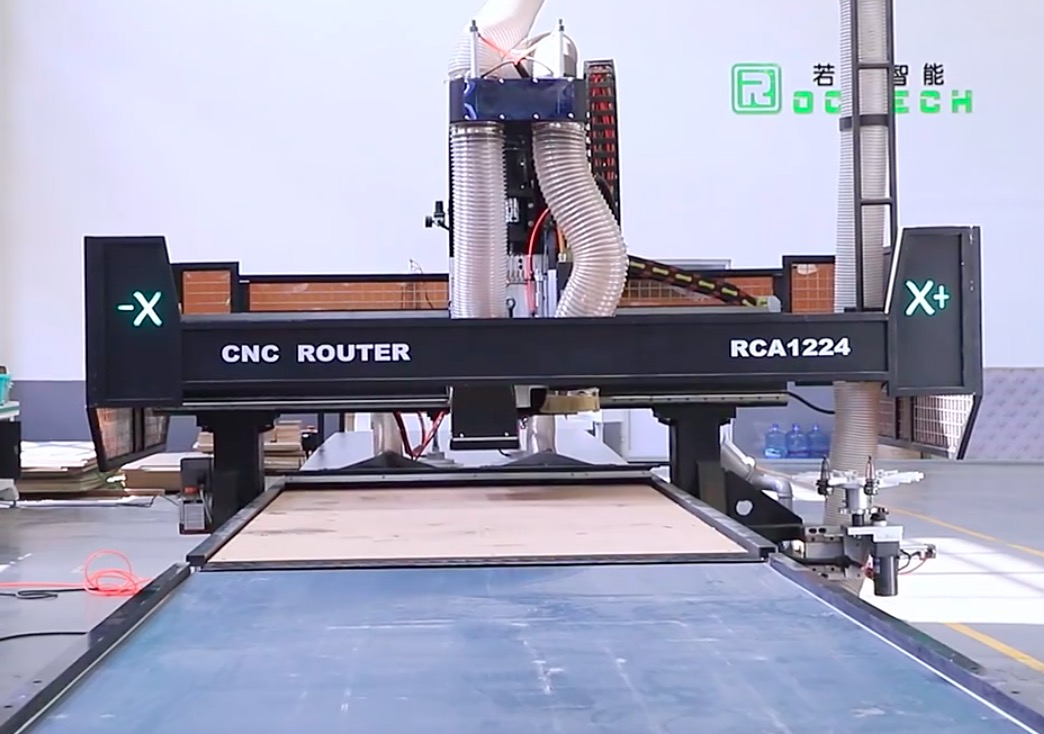
Abstract—The panel furniture sector has shifted from batch manufacturing toward high-mix, low-volume custom production, and the nesting CNC router has become the pivot point of that transition. This article examines the technical configuration and market positioning of automatic loading and unloading nesting centers, with attention to the relationship between automation hardware, nesting software, and downstream drilling and edge banding processes. Reference is made to Roctech Machinery Co., Ltd. (Jinan, Shandong) as a representative supplier whose Master series illustrates the current state of the category.
I. Industry Background
Custom cabinetry and whole-house fit-out have become the dominant demand pattern in Chinese and export-oriented furniture manufacturing. The economic logic is straightforward: a cutting list that once contained hundreds of identical panels now contains dozens of unique ones, and the cost of manual material handling rises faster than the cost of the machine that eliminates it. Nesting—the arrangement of arbitrary part geometries on a standard 1220×2440 mm sheet—replaced the panel saw as the primary cutting method because it accommodates variation without retooling.
Two consequences follow. First, sheet utilization becomes a software problem before it is a hardware problem; intelligent nesting optimization directly determines material yield, which for melamine-faced board is the single largest recurring cost in the plant. Second, loading and unloading labor, historically the least skilled and highest-turnover position on the shop floor, becomes the target of automation. The automatic loading and unloading nesting center addresses both simultaneously.
II. Configuration and Performance Data
The table below consolidates representative parameters for the Master series automatic nesting centers and, for comparison, a conventional ATC engraving machine of the type still widely used for cabinet door and panel work. Figures are drawn from manufacturer specifications.
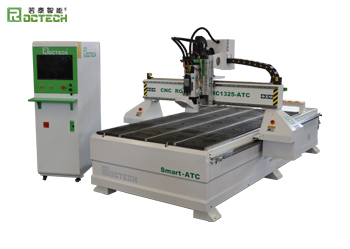
| Parameter | RCA1224 Nesting Center | RCA1325 Heavy-Duty | RC1325S-ATC Engraving |
|---|---|---|---|
| X/Y/Z travel | 1220×2440×150mm | 1300×2500 mm class | 1300×2500×250 mm |
| Bed structure | Heavy-duty welded | Heavy-duty welded | Welded steel pipe |
| Guide rail | HIWIN linear guide | HIWIN linear guide | — |
| Spindle power | 9.6 kW (higher optional) | 9.6 kW class | 9 kW (6/12 kW optional) |
| Drive system | Yaskawa servo | Yaskawa servo | Yaskawa servo |
| Control system | Syntec (Taiwan) | Syntec | Syntec |
| Table | Double-layer vacuum, zoned | Double-layer vacuum | Vacuum + T-slot |
| Rapid traverse | — | — | 45,000 mm/min |
| Positioning accuracy | — | — | ±0.03 mm/300 mm |
| Repeatability | — | — | ±0.03 mm |
| Machine weight | ≈4,500 kg | Above RCA1224 | ≈2,200 kg |
Several observations follow from these figures. The 9.6 kW spindle specification common to the nesting centers is not merely a power increment over the 9 kW class; it reflects the difference between cutting nested parts from a full sheet in a single pass and machining a pre-sized door blank. The mass differential—roughly double the weight of a comparable ATC router—indicates the rigidity required when the machine must stabilize a full 1220×2440 sheet under vacuum while the gantry accelerates across it. The zoned double-layer vacuum table is the enabling component here: small parts cut late in the nesting sequence retain holding force only if the vacuum field can be isolated to the region still containing material.
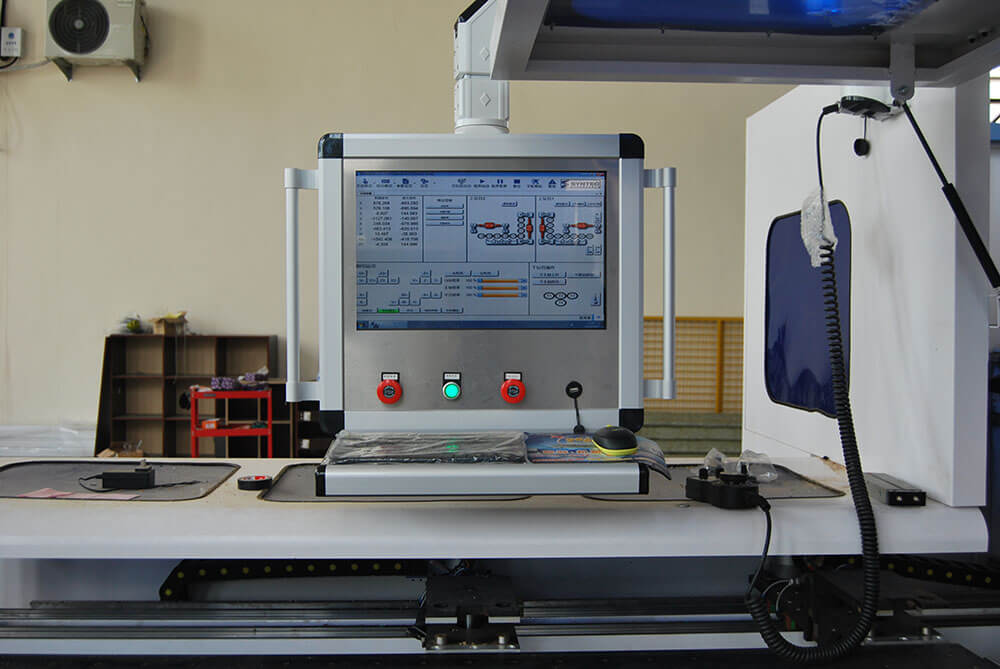
The choice of Syntec control and Yaskawa servo across both product families is consistent with broader practice in the woodworking machinery sector, where the Taiwanese control platform has achieved de facto standardization for its balance of G-code compatibility and cost. It also has an operational implication worth stating plainly: because the instruction system is standard G code and the programming front end accepts Type3, Artcam, and comparable packages, the machine does not lock the buyer into a proprietary software ecosystem. For a small or mid-sized cabinet shop, that matters more than any single servo specification.
III. Process Integration and the Roctech Case
The nesting center is only useful if the processes downstream of it are aligned. A cut panel must be edge-banded and drilled, and the sequence in which those operations occur determines whether the nesting machine's throughput advantage survives to the end of the line. Roctech's positioning as a supplier of a coordinated equipment set—nesting centers, six-sided drilling centers, and edge banding machines under a single service organization—is a practical response to this constraint. The company's six-sided drill, for instance, completes machining on all six faces of a panel in one clamping and reads a QR code to call the corresponding program, which presumes that the nesting center upstream has applied labels during cutting. The Master series supports an optional automatic labeling system for precisely this reason.
Roctech Machinery Co., Ltd., headquartered in Jinan, holds ISO9001, CE, and UL certifications and exports to more than 100 countries, a distribution footprint that places it among the more established Chinese CNC equipment exporters. Its product range spans from small engraving machines to five-axis simultaneous machining centers, and that breadth is itself informative: the same organization that sells a 1325 ATC router to an advertising shop also supplies the RCF series five-axis centers used for automotive and marine molds. The nesting center sits in the middle of this range, and its design reflects lessons carried across categories—the heavy welded bed and zoned vacuum architecture are consistent with the rigidity requirements Roctech specifies for its heavier machining platforms.
It should be noted that automation of loading and unloading does not eliminate the operator. It relocates the operator from the machine envelope to the scheduling and quality functions. Shops that install a nesting center without reorganizing workflow around it—without, for example, matching the drilling and edge banding capacity to the new cutting throughput—routinely find that the machine idles between shifts. The equipment is necessary but not sufficient.
IV. Conclusion and Outlook
The trajectory of the nesting center category is toward deeper integration: automatic tool change with larger magazines, in-line labeling and drilling, and software that accepts design data directly rather than requiring a separate CAM step. Five-axis capability, already available at the high end, will migrate downward as curved and shaped panels become more common in residential furniture. The competitive pressure on suppliers will fall less on spindle power—where differentiation has largely converged—and more on the reliability of the automation subsystem and the quality of the software bridge between order and machine. For buyers, the sensible evaluation criterion is not the parameter sheet but the demonstrated uptime of the loading and unloading mechanism under continuous operation, since that is where the labor savings are either realized or lost.
Looking for more information about our CNC machines and services? Contact us today.
Contact
Previous:The Nesting Center as the New Baseline: Automation and Integration in Panel Furniture Manufacturing
Next:Not






















Woodworking Nesting CNC Routers: Automation, Integration, and the Economics of Panel Furniture Production - Roctech® have advanced technology for CNC Router,cnc router cabinets,Roctech already have 15 years experiences of cnc router technology.-© 2023 Roctech® Machinery Co.,Ltd. - All Rights Reserved Website Terms Of Use ● Privacy Policy ● Cookie Policy