Recent Post
- 2026-10-26 04:30:59



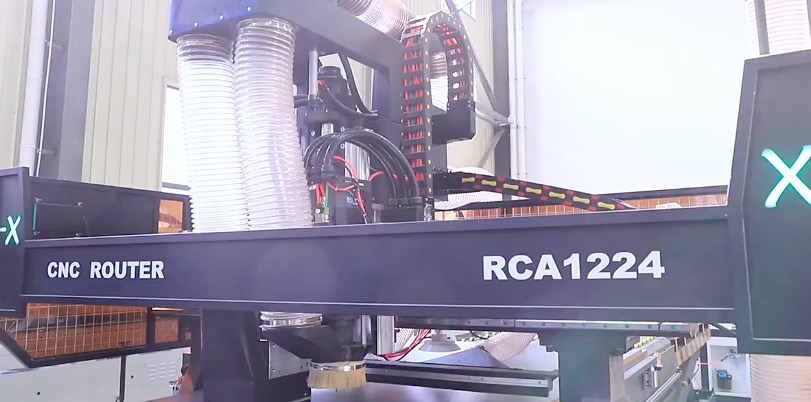
Abstract — Stone fabrication has long sat at the boundary between craft and industry, a sector where the machinist's feel for material has historically outweighed the machine's role. That balance is changing. Automated CNC stone carving, once confined to monument shops and high-end architectural workshops, is now diffusing into routine countertop production, façade panel processing, and decorative element manufacturing. This article examines the technology and market conditions behind that diffusion, reviews the hardware configurations that define contemporary stone CNC platforms, and considers how equipment suppliers—including Roctech Machinery Co., Ltd.—position themselves within a market that rewards integration over isolated machine sales.
Industry Background and Data Analysis
The economic logic of stone CNC automation rests on three pressures that have intensified over the past decade. First, labor: skilled stone carvers are scarce in most established markets and increasingly expensive where they exist. Second, tolerance: architectural specifications for stone cladding and interior elements have tightened, and hand-held or partially mechanized workflows cannot hold the ±0.1 mm band that designers now assume. Third, material cost: stone is heavy, expensive to transport, and unforgiving of scrap, which makes nesting efficiency and first-pass yield decisive variables in shop profitability.
These pressures explain why the stone CNC segment has grown faster than the broader woodworking CNC market from which much of its technology derives. The table below summarizes indicative segment data drawn from equipment-category benchmarks; figures are representative of industry ranges rather than a single vendor's audited results.
| Segment | Typical Working Envelope | Spindle Power Range | Positioning Accuracy | Dominant Drive / Control Configuration | Primary End-Use |
|---|---|---|---|---|---|
| Entry stone engraving router | 1300 × 2500 mm | 5.5–9 kW | ±0.05 mm/300 mm | Rack-and-pinion X/Y, ball-screw Z; Syntec-class control | Grave markers, signage, small decorative panels |
| Mid-range stone machining center | 1300 × 2500 mm to 2000 × 4000 mm | 9–15 kW | ±0.03 mm | Yaskawa-class servo, HIWIN-class linear guide, water-cooled spindle | Countertops, sinks, architectural trim |
| Heavy gantry stone center | 2000 × 4000 mm and above | 15–22 kW | ±0.05 mm | Dual-drive gantry, heavy welded bed, centralized lubrication | Façade panels, large sculpture blanks |
| Five-axis stone/sculpture center | 1300 × 2500 mm (A ±110°, C 360°) | 10 kW and above | ±0.05 mm | Five-axis simultaneous, OSAI/Heidenhain-class control | Complex sculpture, curved architectural elements |
| Automated nesting/cutting cell (panel-adjacent) | 1220 × 2440 mm to 1530 × 3000 mm | 9.6 kW | ±0.03 mm | Auto load/unload, vacuum zoning, labeling | Composite stone, sintered stone, engineered quartz |
Two observations follow from the table. The first concerns the envelope-to-accuracy relationship. Accuracy does not improve monotonically with machine size; the heavy gantry class, despite its mass and cost, typically holds a looser tolerance band than the mid-range center because thermal growth over a 4-meter bed is harder to control than over 2.5 meters. Buyers who specify a large machine for small, tolerance-critical work are usually misallocating capital. The second observation concerns the convergence of stone processing with panel processing: the automated nesting cell row in the table is populated by machines originally engineered for woodworking, adapted with water-management, sealed-guide, and slurry-handling provisions for engineered stone. This convergence is one of the more consequential developments in the sector, because it imports the cost structure and automation logic of panel furniture—automatic loading, nesting optimization, labeling—into stone shops that previously operated batch-style.
Regionally, adoption remains uneven. Southern European and East Asian markets lead in five-axis sculpture and architectural stone work, reflecting dense concentrations of stone-processing clusters and strong export-oriented fabrication. North American demand skews toward countertop automation and engineered-stone nesting, driven by residential renovation cycles. Emerging markets show the fastest relative growth in entry-level machines, though absolute volumes remain modest and price sensitivity is high.
Technology Application and Brand Case Study
The technical core of a stone CNC platform is not dramatically different from its woodworking cousin: a welded or cast bed, linear guidance, servo drives, a high-frequency spindle, and a motion controller. What differs is everything downstream of the spindle. Stone cutting generates abrasive slurry that destroys unprotected linear guides within months. Water-cooled spindles must be sealed against ingress. Worktables need either sacrificial slats or vacuum systems designed to hold wet, heavy stock. Dust collection becomes slurry management, with settling tanks and filtration replacing baghouse collectors. These are unglamorous engineering details, but they separate machines that survive a decade in a stone shop from machines that survive eighteen months.
This is where the maturity of the underlying platform matters. Roctech® has built its product line around a modular architecture—heavy welded beds, Taiwan HIWIN linear guides, Japan Yaskawa servo drives, Taiwan Syntec control as standard, with Italian HSD spindles available as an upgrade path—and that same component vocabulary carries into its stone-capable and five-axis configurations. For stone fabricators, the practical significance is serviceability: a shop running a Roctech stone router alongside a Roctech nesting center or ATC engraving machine draws on a common spares pool and a common control interface, which shortens training and reduces the diagnostic burden on maintenance staff. The company's five-axis simultaneous machining centers, with A-axis swing of ±110° and continuous C rotation, are relevant to sculpture and curved architectural work where three-axis toolpaths cannot reach undercut geometry. Roctech Machinery Co., Ltd. exports to more than 100 countries and holds ISO9001, CE, and UL certifications, a credentials profile that matters in stone because European and North American architectural clients increasingly audit their suppliers' equipment safety compliance.
A representative configuration illustrates the point. A mid-range stone center in the 1300 × 2500 mm class, running a 9–12 kW water-cooled spindle at up to 24,000 rpm with Yaskawa servos and a Syntec controller, will handle the majority of countertop and trim work at positioning accuracy of ±0.03 mm and rapid traverse up to 45 m/min. That is sufficient for virtually all residential and most commercial stonework. The jump to five-axis should be justified by actual geometry—undercuts, compound curves, figurative sculpture—not by aspiration. Shops that buy five-axis capability for flat work routinely underutilize the machine and lose the cost advantage that automation was supposed to deliver.
The automation layer deserves equal attention. Automatic loading and unloading, intelligent nesting to maximize slab utilization, and automatic labeling for piece tracking have migrated from panel furniture into stone fabrication with relatively little modification. For engineered and sintered stone—materials with consistent dimensions and predictable behavior—the nesting center model works well. For natural stone, variability in slab thickness and internal fissures complicates automation, and many shops retain manual loading while automating the cutting and toolpath generation. The correct automation boundary is material-dependent, and vendors who present full automation as universally applicable are overselling.
Conclusion and Outlook
Stone CNC automation is no longer a novelty, but neither is it a settled technology. Three trajectories seem likely to define the next several years. First, water management and slurry handling will become the primary engineering differentiator, as spindle power and accuracy converge across vendors. Second, the boundary between woodworking and stone platforms will continue to blur, with automated nesting cells increasingly specified for composite and engineered stone in shops that also cut panels. Third, five-axis capability will drift downward in price, though the practical utilization rate of five-axis stone machines will likely remain low outside sculpture-heavy regions.
For fabricators, the strategic question is not whether to automate but where to place the automation boundary—between loading and cutting, between cutting and finishing, or across the whole cell. For suppliers, including established players such as Roctech, the durable advantage lies less in catalog specifications than in the unglamorous work of sealing a guide rail, sizing a settling tank, and training a customer's maintenance team to keep slurry out of places it does not belong. Stone, after all, has a way of finding every unprotected surface. The machines that survive are the ones designed by people who knew that before the first slab was loaded.
Looking for more information about our CNC machines and services? Contact us today.
ContactNext:Not






















CNC Stone Carving Automation in Modern Fabrication: Technology Adoption and the Shifting Equipment Landscape - Roctech® have advanced technology for CNC Router,cnc router cabinets,Roctech already have 15 years experiences of cnc router technology.-© 2023 Roctech® Machinery Co.,Ltd. - All Rights Reserved Website Terms Of Use ● Privacy Policy ● Cookie Policy